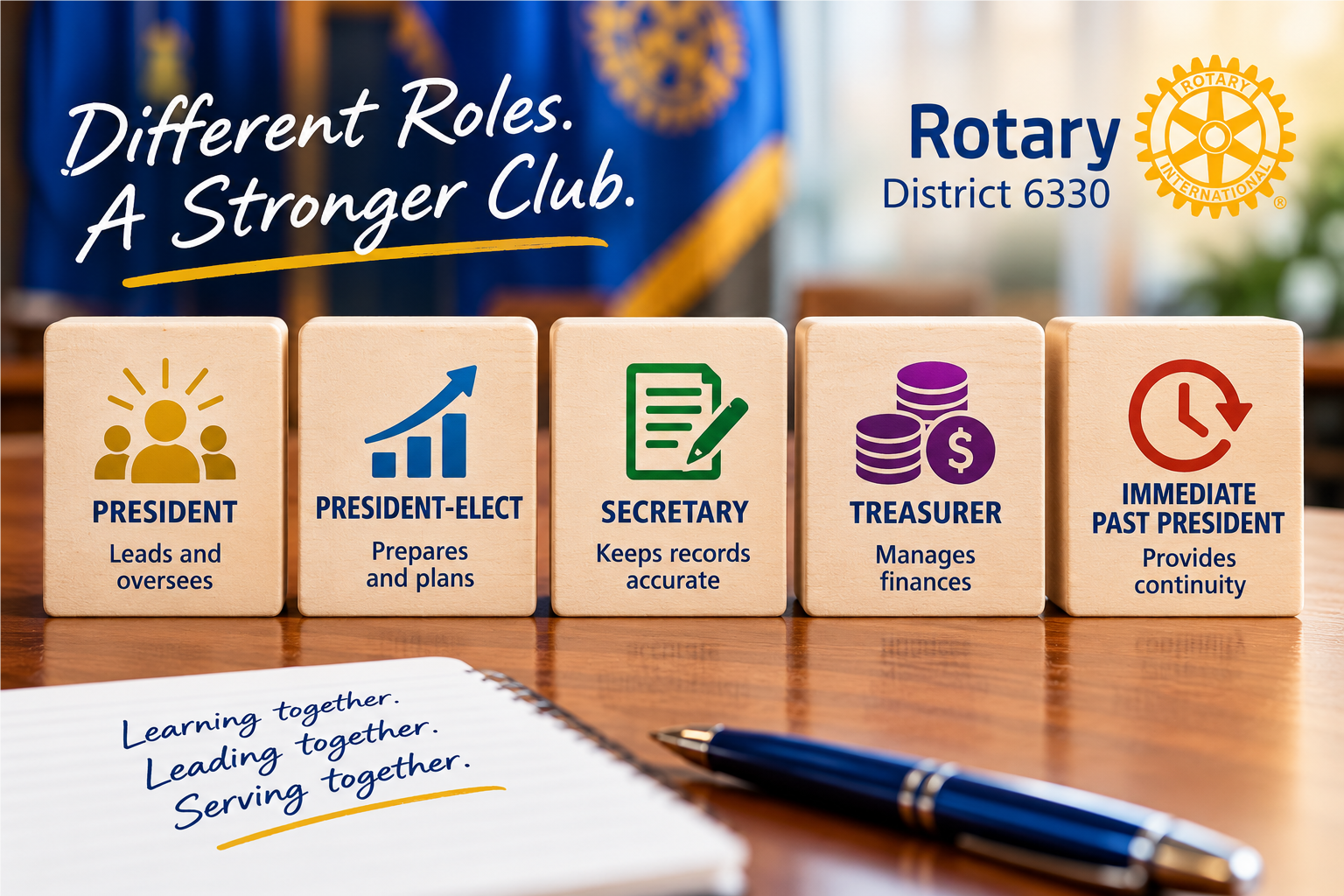
Strong Rotary clubs don’t happen by accident. They depend on members stepping into leadership roles with a clear understanding of what those roles involve.
But there can be confusion.
What exactly is the President responsible for? What should the President-Elect be doing before July 1? What does the Secretary absolutely need to keep current? What is the Treasurer responsible for? And what, exactly, is the role of the Immediate Past President?
Just as importantly, how do we know whether something is actually required by Rotary International — or whether it is simply something our club has always done?
Let’s take a closer look.
President — Lead, Coordinate and Oversee
The Club President provides leadership to the club and works with the board, committees and members to help the club accomplish its goals.
Among the President’s key responsibilities are presiding over club and board meetings, supporting the work of club committees, conducting club assemblies, working with district leadership, and helping ensure the club’s administrative, financial and governance responsibilities are being carried out.
That last point is important.
The President does not have to personally do everything — but should know that the important things are getting done.
A good President understands the club’s goals, knows who is responsible for what, keeps the board and committees moving forward, and makes sure important responsibilities don’t fall through the cracks.
President-Elect — Prepare Now, Not July 1
President-Elect is not a waiting position.
The President-Elect year is the opportunity to learn, plan and prepare for the year ahead. Rotary expects incoming Presidents to participate in appropriate president-elect training and district learning opportunities and to prepare for their leadership year.
This is the time to assess the club, work with the incoming leadership team, establish goals, develop plans for achieving those goals, identify committee leadership and think about continuity of projects and priorities.
Ideally, July 1 should not be the day a new President starts figuring out how to be President.
It should be the day a prepared President begins implementing a plan.
Secretary — Keep the Club’s Information Accurate
The Club Secretary plays a critical role in keeping the club organized and connected with Rotary International.
Responsibilities generally include maintaining appropriate club records, membership and officer information, minutes and required notices, as well as ensuring information reported to Rotary International is accurate and current.
One particularly important area is membership reporting.
Membership information recorded with Rotary International matters, including around July 1 and January 1, when Rotary determines club membership for invoicing purposes.
An outdated membership list isn't simply an administrative inconvenience — it can have financial consequences for the club.
The Secretary therefore plays an important role in making sure that the club's official information reflects what is actually happening in the club.
Treasurer — Understand and Report the Club’s Finances
The Club Treasurer is responsible for the financial administration of the club.
This includes managing club funds, collecting and submitting dues and fees, paying appropriate invoices, maintaining financial information and regularly reporting the club's financial position.
The Treasurer should also understand the club's obligations to Rotary International and, where applicable, financial matters involving The Rotary Foundation.
The Treasurer and Secretary should work closely together.
Why?
Because membership and money are connected. Changes in membership can affect Rotary International dues and club invoicing, so accurate records and good communication between these two officers are essential.
The Treasurer should also ensure that financial records and responsibilities are transferred appropriately to the incoming Treasurer at the end of the Rotary year.
Immediate Past President — Provide Continuity
The Immediate Past President has something no other member of the incoming leadership team has: the experience of having just served as President.
That experience can be extremely valuable.
The Past President can provide context about previous decisions, ongoing projects, relationships, commitments and issues that may carry over from one Rotary year to the next.
Unlike some other officer positions, however, Rotary International does not prescribe an extensive universal list of operational responsibilities for every Immediate Past President. Additional responsibilities may be established through the club's own bylaws or practices.
The Past President's most valuable contribution may simply be continuity — helping new leadership move forward without having to rediscover everything the previous leadership team already learned.
And there is another important aspect to this role: supporting the new President without continuing to be the President.
Good leadership transition means passing both the responsibility and the authority to lead.
Three Things Every Rotary Club Officer Should Know
Understanding your job description is only part of being an effective Rotary leader.
Every club officer should also understand that club practices generally fall into three different categories:
What Rotary International requires.
What your own club bylaws require.
What your club has simply always done.
They aren't necessarily the same thing.
1. What Rotary International Requires
Some responsibilities arise from Rotary International's constitutional documents, policies and established requirements.
These include fundamental aspects of club governance and administration, such as maintaining required membership and club information, electing officers, meeting financial obligations to Rotary International and operating within Rotary's constitutional framework.
These aren't simply local customs. They are part of operating as a Rotary club.
Club leaders should therefore become familiar with Rotary International's governing documents and the resources and Learning Center materials provided for their particular roles.
You don't need to memorize Rotary's entire governance structure.
You should, however, know where to look when a question arises.
2. What Your Club Bylaws Require
Rotary clubs also have considerable flexibility in determining how they operate.
Your club's bylaws fill in many of the operational details.
They may establish the composition of your board, additional officer positions, committee structure, election procedures, meeting practices and responsibilities assigned to particular directors or officers.
That leads to an important distinction:
Something can be mandatory in your club without being mandatory in every Rotary club.
Every incoming officer should therefore know where to find a current copy of the club's constitution and bylaws — and ideally, actually read them.
And what happens if your club has been operating differently from what its bylaws say?
That doesn't necessarily mean the current practice is wrong.
It may mean the bylaws need to be reviewed and updated through the appropriate process.
3. What Your Club Has Simply Always Done
Then there is Rotary tradition.
Every club has it.
You might hear:
“The Past President always does that.”
“That's the Secretary's job.”
“We've always had that committee.”
“We have to do it that way.”
Or perhaps the most famous explanation of all:
“That's just the way we've always done it.”
There is nothing inherently wrong with tradition. In fact, traditions can be an important part of a Rotary club's culture and identity.
But tradition should not automatically be confused with a Rotary International requirement or a requirement contained in your club's bylaws.
So the next time someone says:
“Rotary requires us to do this.”
There is a very reasonable question to ask:
“Where is that requirement written?”
You might discover that it is indeed a Rotary International requirement.
You might discover that it comes from your club's bylaws.
Or you might discover that someone started doing it 25 years ago and nobody ever asked why!
And that's okay.
Once you know the difference, your club can make an informed decision about whether that tradition still serves the club.
Take This Learning Moment Back to Your Club
At your next board meeting, try a simple exercise.
Choose one or two things your club has “always done” and ask:
Is this required by Rotary International?
Is it required by our club constitution or bylaws?
Or is it simply our club's practice or tradition?
Then ask one more question:
If it is simply our practice, does it still help us operate as an effective Rotary club?
Keep the traditions that serve your club.
Change the practices that no longer do.
And make sure the things that truly are required never get overlooked.
Because understanding the difference between requirement, governance and tradition isn't just good administration.
It's good Rotary leadership.
That’s your Rotary Learning Moment!
Rotary International District 6330 — Learning together. Leading together. Serving together.